
Your cart is empty
Browse OfferingsLicensed & Affiliated


Ethio Coffee Import and Export PLC is a family-owned Ethiopian coffee exporter shipping green coffee beans to roasters, importers, and distributors worldwide.
© 2026 Ethio Coffee Import and Export PLC. All rights reserved.
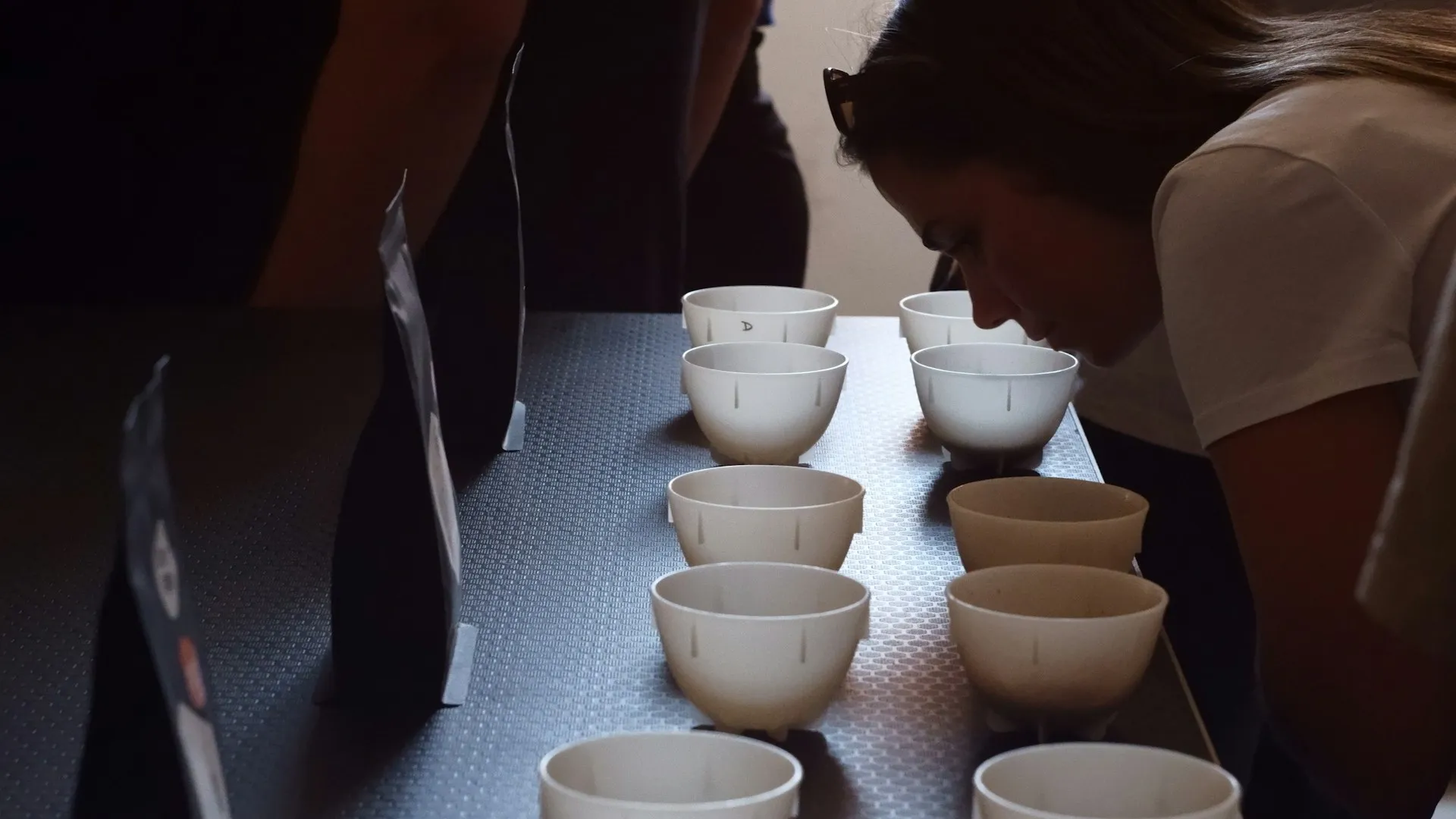
Photo: Lena Bochanova, Unsplash.
A green coffee quality control lab needs four things before it needs expensive instruments: a stable, odor-free room with neutral light of roughly 4000 K, a precision scale, a moisture meter, and a repeatable cupping setup. That starter bench costs roughly USD 2,500 to 4,500 at 2026 list prices and already catches the defects and moisture problems that cause most quality claims. Add a dedicated sample roaster when offer-sample volume justifies it, and a water activity meter and QC software when you hold inventory across seasons. Match every instrument to a specific buying decision, and calibrate the lab against your supplier's origin lab in the first season, or the numbers will disagree when it matters most.
A green coffee quality control lab is the difference between buying coffee on evidence and buying it on trust. Every serious importer and a growing share of mid-size roasters now run some version of one: a controlled space where offer samples, pre-shipment samples, and arrival lots are weighed, measured, roasted, and cupped under repeatable conditions. The equipment list is not the hard part. The hard part is knowing which instruments actually change a buying decision, what they cost in 2026, and how to make your numbers agree with the exporter's numbers 10,000 kilometers away.
This guide covers the physical room, three equipment budget tiers, the mapping between tests and buying stages, and the calibration work that makes a lab trustworthy. It does not re-teach the individual protocols; the site already has dedicated guides to cupping Ethiopian samples, moisture and water activity, and defect grading. This article is about building the room where those protocols run.
A QC lab exists to answer three commercial questions: should we buy this coffee, did the shipped coffee match what we approved, and is our stored coffee still the coffee we bought. Each question protects a different sum of money, and together they justify the lab many times over. A single 20-foot container of specialty Ethiopian coffee holds around 19,200 kg; at a 2026 contract price of USD 5.50 per kg FOB, that is roughly USD 105,600 committed before freight, duty, and financing. A starter lab costing under USD 5,000 pays for itself the first time it stops one bad container or documents one successful claim.
The lab also changes the relationship with suppliers. When a buyer sends structured cupping scores and physical measurements back to an exporter, sample quality conversations move from opinion to data. Buyers who reject a lot with a defect count and a roast photo get faster, more constructive responses than buyers who write "the coffee tastes off." If a dispute does escalate, lab records are the backbone of a green coffee quality claim.
The minimum viable QC space is 10 to 15 square meters: enough for a grading bench, a cupping table, and sample storage that does not share air with production roasting. The room matters more than most equipment because every sensory evaluation inherits its conditions. Grading green color under warm yellow light, or cupping next to a roaster exhaust, quietly biases every decision made in the room.
None of this requires construction. A spare office, painted neutral and fitted with two daylight-balanced LED panels and a carbon-filtered water source, meets the specification. What it cannot be is a corner of the roastery floor; airborne chaff and roast smoke make consistent sensory work impossible.
Buy equipment in the order that buying decisions demand it, not in the order catalogs present it. The tiers below reflect indicative 2026 list prices from lab equipment vendors, rounded; confirm current quotes before budgeting. Tier 1 makes physical intake checks and basic cupping possible. Tier 2 makes evaluation independent of the production floor. Tier 3 supports importers and multi-site roasters holding inventory across seasons.
| Item | Indicative 2026 Price (USD) | Decision It Supports |
|---|---|---|
| Precision scale (0.1 g) | 100 - 300 | Defect counts per 350 g, cupping doses, roast loss |
| Capacitance moisture meter | 1,100 - 1,500 | Accept or query moisture at intake and arrival |
| Grading sieves (screens 8 - 20) | 300 - 500 | Verify screen size against the contract spec |
| Grading trays, matte placemat, defect reference | 150 - 350 | Structured physical inspection and defect classing |
| Cupping bowls, spoons, kettle, timer, spittoon | 250 - 500 | Repeatable sensory evaluation |
| Burr grinder (lab-reserved settings) | 300 - 800 | Consistent grind for cupping |
| Daylight-balanced lighting retrofit | 100 - 300 | Accurate green and roast color judgment |
At Tier 1 the sample roast still happens on the production machine or a small home-scale roaster, which is workable if the roast is logged and repeated. Use a written green coffee sample roasting protocol to define the machine state, batch, endpoint, cooling, roast-acceptance gate, and repeat rule. The SCA and CQI green grading protocols call for at least 350 g of green coffee per graded sample (Cropster, 2024), so ask exporters for sample sizes that allow a full physical workup plus a roast.
Tier 2 exists to remove the production floor from the evaluation loop. Its core purchase is a dedicated electric sample roaster, typically USD 3,000 to 9,000 at 2026 list prices depending on barrel count, so offer samples no longer wait for a gap in the production schedule. Add a lab-only grinder (USD 800 to 1,500), a roast color analyzer (around USD 1,400 to 2,500) to standardize sample roast development, a bulk density measure, filtered water plumbed to the cupping bench, and sealed cabinets for a retention sample library. A roaster at this tier can turn an offer sample around in 48 hours, which matters when fresh-crop Ethiopian lots sell on allocation.
A density measure earns its bench space only when every operator fills it the same way. Use our green coffee density quality-control protocol to define the vessel, three-reading method, lot record, and retest trigger before origin and destination numbers enter the same file.
Tier 3 instruments protect inventory value across time rather than single purchases. A water activity meter (roughly USD 3,000 to 6,000 in 2026) predicts how coffee will age in storage, which is why importers holding lots across seasons buy one before roasters do; the reasoning is covered in the moisture and water activity guide. Multi-barrel gas sample roasters (USD 10,000 to 25,000) let a lab roast four to eight samples in parallel during arrival season. QC software platforms that link green measurements, roast curves, and cupping scores typically run USD 1,000 to 3,000 per year. Climate control for the green sample store completes the tier.
Buying rule: every instrument must name the decision it changes. A refractometer is popular, but if no buying decision in your workflow turns on extraction percentage, it is decor. A second moisture meter for cross-checking drift, unglamorous as it is, changes accept-or-claim decisions and earns its bench space first.
A lab earns its cost only when each test runs at the stage where its result can still change an outcome. The three-gate structure of offer sample, pre-shipment sample, and arrival sample is described in the sample approval guide; the table below shows what the lab runs at each gate and why.
At arrival, the laboratory is one part of a wider control. The green coffee receiving inspection checklist connects these tests to container condition, bag reconciliation, quarantine, exception handling, and the final inventory-release decision.
| Buying Stage | Lab Work | Decision on the Table |
|---|---|---|
| Offer sample | Full physical workup, sample roast, cupping; screen check against spec | Contract or pass; price versus quality |
| Pre-shipment sample | Cup against the approved offer sample; moisture; defect recount | Release the shipment or hold it at origin |
| Arrival | Moisture and water activity versus PSS record; cup against retained PSS | Accept, negotiate, or open a documented claim |
| Storage (quarterly) | Re-cup held lots; spot moisture checks | Roast now, blend down, or hold |
| Pre-production | Confirm the production lot matches the approved arrival profile | Schedule the roast or flag substitution |
Specialized food-safety testing stays external. Mycotoxin screening, pesticide residue panels, and similar analyses belong with accredited third-party laboratories, not on your bench; the mycotoxin testing guide covers when those tests are worth commissioning. The in-house lab's job is to know when to send something out.
An uncalibrated lab produces confident numbers that cannot be compared with anyone else's. Calibration has two halves: instruments and people. Instruments drift; moisture meters in particular should be checked monthly against a reference sample or a second meter, and scales verified with a calibration weight. Log every check. The log is what makes your arrival measurement credible in a dispute.
Palate calibration is harder and more valuable. The SCA's Coffee Value Assessment standards SCA-102 through SCA-104 were adopted as the official cupping standards in November 2024 and superseded the 2004 cupping protocol; the SCA Coffee Value Assessment guide explains the transition. Pick one system, train every cupper in it, and use the detailed coffee cupping calibration protocol for buying teams to measure score spread, duplicate repeatability, descriptor alignment, and defect detection. Published SCA standards are available from the Specialty Coffee Association standards library.
Then calibrate outward. In the first season with a new exporter, cup the same lots they cup and exchange scores. Expect a spread of one to two points from water chemistry, roaster type, and days off roast alone; the goal is not identical numbers but a known, stable offset. Once you know your lab scores a typical washed Yirgacheffe about one point under the origin lab, a three-point gap on a future sample becomes a real signal instead of noise.
Every sample that enters the lab should leave a record and, where a purchase followed, a physical twin. Keep 100 to 200 g of every approved pre-shipment sample sealed, labeled, and stored in the lab until the lot is fully roasted or the claim window has closed. That retained sample is the only physical evidence of what was approved if the arrival cup diverges.
The record itself can start as a spreadsheet: sample ID, lot reference, receipt date, moisture, screen distribution, defect count, roast log, cupping score, decision, and evaluator. What matters is that the same fields are captured every time, that records link back to the contract, and that the buying team can query them a season later. Move to dedicated QC software when volume makes the spreadsheet the bottleneck, not before. Labs that skip record discipline end up re-cupping from memory, and memory always flatters the coffee you already bought; the same failure mode that undermines green coffee inventory management when lot data lives in someone's head.
Your lab is one end of a paired system; the exporter's lab is the other. Knowing what happens at origin tells you what your own bench must verify versus what it can trust. In our Addis Ababa lab, every pre-shipment sample is drawn after dry milling, cupped against the approved offer sample, and only then couriered; a sealed twin of that PSS stays on the shelf in Addis so that both sides can re-cup the identical coffee if an arrival dispute opens months later.
Two origin-side realities are worth designing your lab around. First, altitude: Addis Ababa sits at roughly 2,355 meters, where water boils near 92°C, so sample roasts and cupping brews behave differently than they will in a sea-level lab in Hamburg or Osaka. This is one reason origin and destination scores rarely match exactly, and why we encourage first-season buyers to run shared calibration cuppings rather than assume one lab is wrong. Second, naturals hide their defects from green inspection: quakers barely show in unroasted coffee and only reveal themselves as pale beans after the sample roast. Origin labs roast-check natural lots before release for exactly this reason, and a buyer's lab should never grade a natural on green inspection alone.
A useful habit: ask any exporter you evaluate what their lab measures before dispatching a PSS, and compare it against the checks in the supplier evaluation checklist. An exporter who can answer precisely is an exporter whose numbers your lab can calibrate against.
Consider a Rotterdam roaster processing 120 tonnes of green coffee per year, buying eight to ten Ethiopian and Latin American lots annually, who until now has cupped on the production roaster and trusted supplier certificates for physical specs. Built in one step, a full lab is a USD 40,000 capital request that finance will question. Staged against decisions, it funds itself.
Starter bench in a converted office: scale, moisture meter, sieves, cupping kit, lighting. Every arrival now gets a moisture reading and a defect count against the contract. In the first year this documents one moisture discrepancy on a 19,200 kg container, recovering more than the bench cost in a negotiated settlement.
Dedicated two-barrel sample roaster, lab grinder, roast color analyzer, retention cabinets. Offer samples turn around in two days instead of two weeks, and the roaster stops losing allocation-season Ethiopian lots to slower evaluation. PSS approvals now cup against the retained offer sample.
Water activity meter and QC software as the roaster starts holding fresh-crop volume across two quarters. Quarterly re-cups plus water activity trends decide which held lots roast first, protecting inventory the finance team already paid for.
Each stage was approved because a named, recurring decision lacked data: arrival acceptance, offer turnaround, storage sequencing. No instrument was bought for completeness. This is the pattern that keeps a QC lab a profit protector rather than a cost center.
Most new labs fail through process gaps rather than equipment gaps. These six recur across the buyers we work with.
Avoid those six and even a modest green coffee quality control lab becomes what it should be: the cheapest insurance a coffee buyer can own, and the fastest way to make supplier relationships more honest in both directions.
Request current-crop Ethiopian offer samples with full lot documentation, cup them against our Addis Ababa lab's scores, and calibrate your bench against origin from the first contract.
A functional starter lab costs roughly USD 2,500 to 4,500 at 2026 list prices: precision scale, capacitance moisture meter, grading sieves, cupping kit, and daylight-balanced lighting. A dedicated lab with its own sample roaster adds USD 8,000 to 15,000, and importer-grade instruments such as water activity meters add USD 15,000 to 40,000 more.
Buy the instruments that gate arrival acceptance first: a 0.1 g precision scale, a moisture meter, grading sieves, and a repeatable cupping setup. These catch the moisture, screen size, and defect discrepancies behind most quality claims. A dedicated sample roaster comes next, once offer-sample volume justifies removing production from the loop.
Yes, at low volume. Physical intake checks need no roaster at all, and cupping roasts can run on a logged, repeated profile on the production machine or a small home-scale roaster. The compromise is turnaround and consistency, so buy a dedicated sample roaster when offer samples start waiting on the production schedule.
Plan 10 to 15 square meters for a grading bench, cupping table, and sealed sample storage. The binding constraints are environmental rather than spatial: neutral light near 4000 K, air free of roast exhaust and odors, stable temperature of 20 to 25 degrees Celsius, and moderate humidity around 50 to 65 percent.
Cup the same lots in the same season and exchange scores, roast logs, and physical measurements. Expect a stable offset of one to two points from water chemistry, altitude, roaster type, and sample age rather than identical numbers. Once that offset is known, larger gaps on future samples become genuine quality signals.
About This Insight: Written by Ethio Coffee Import and Export PLC, an origin-connected Ethiopian coffee exporter with three decades of sourcing relationships across Yirgacheffe, Sidamo, Guji, Harar, Limu, and Jimma. Published Jul 15, 2026.