
Your cart is empty
Browse OfferingsLicensed & Affiliated


Ethio Coffee Import and Export PLC is a family-owned Ethiopian coffee exporter shipping green coffee beans to roasters, importers, and distributors worldwide.
© 2026 Ethio Coffee Import and Export PLC. All rights reserved.
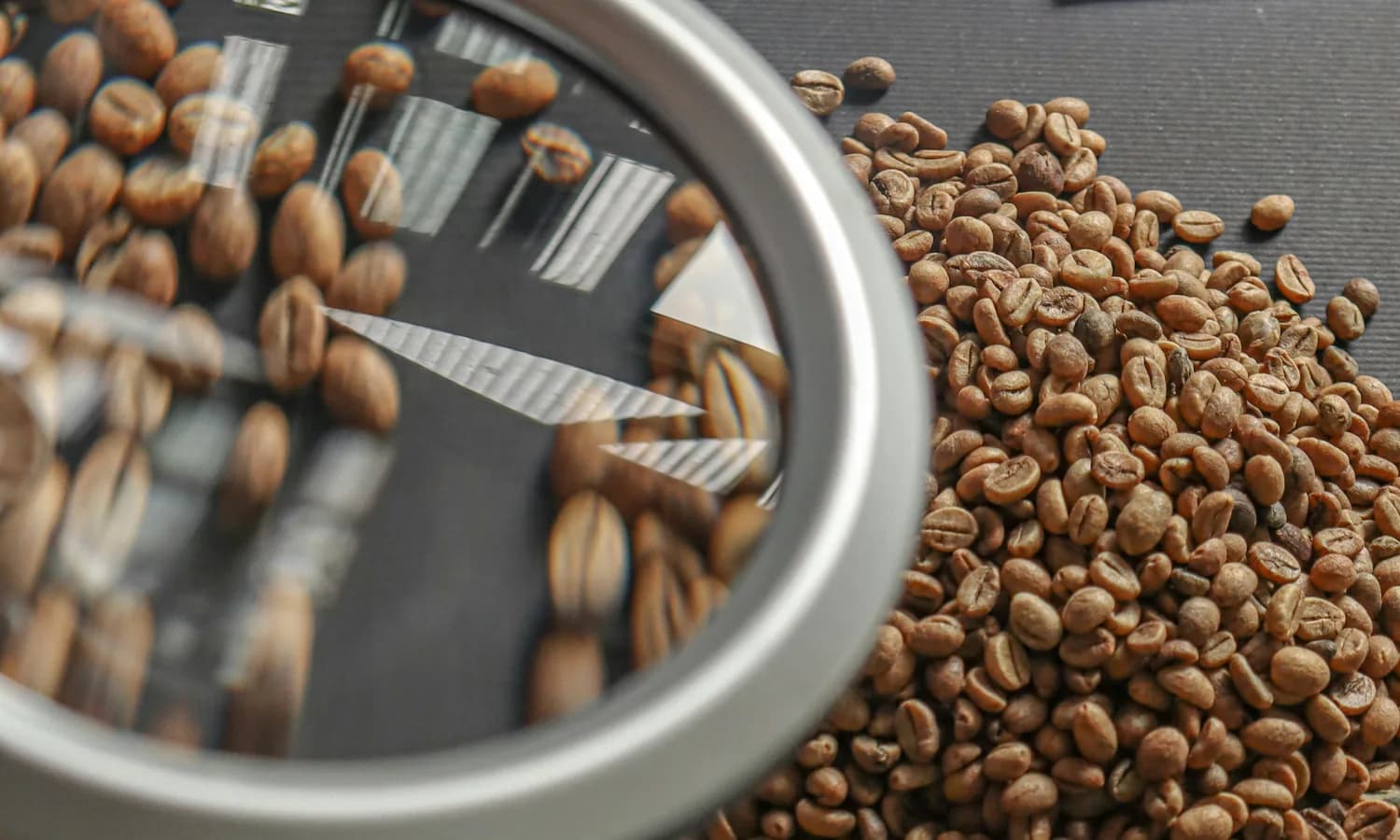
Green coffee density is useful only when the measurement method travels with the number. Record free-flow bulk density in grams per litre, use the same vessel and filling technique, take three readings, and report the median with moisture, sample stage, lot code, and measurement date. Buyers should use density as a trend and consistency signal, not as a universal quality grade. A result that shifts between an approved pre-shipment sample and arrival deserves investigation, while a stable result gives the roasting team a stronger starting point for production trials.
Green coffee density often appears on a lot sheet as a confident three-digit number, then disappears from the buying decision because nobody knows how it was produced. That wastes a valuable quality-control signal. Density can help an importer detect lot inconsistency, give a roaster a better production starting point, and document physical change after shipment, but only when origin and destination teams use a shared protocol.
The central problem is method variation. Scooping, pouring, tapping, vessel shape, sample temperature, bean moisture, and even the way an operator levels the top can change the reading. A supplier may report 720 g/L and a buyer may record 695 g/L without either instrument being faulty. Treating those results as directly equivalent creates false alarms. Ignoring them entirely throws away evidence.
This protocol gives green buyers, importer quality teams, and production roasters one controlled workflow. It does not replace cupping, physical grading, or the moisture and water activity checks that establish storage risk. It adds a repeatable structural measure that connects the offer, approval, arrival, and roast-planning stages.
Green coffee bulk density is the mass of whole beans occupying a known volume, including the air spaces between them. In commercial quality control it is normally expressed in grams per litre (g/L). The number describes the sample and the way it packed into the vessel, not the solid material density of an individual bean.
The distinction matters because bean shape and size affect how much open space remains in a filled container. The ISO 6669:1995 standard, last confirmed by ISO in 2018 and under review in 2026, defines a routine free-flow method for whole green and roasted coffee. “Free-flow” means the sample moves from one container into another without intentional compaction.
Write “free-flow bulk density, g/L” in the lot record. Do not shorten it to “hardness,” “specific gravity,” or “bean density” if the test used a volume vessel and a scale. Those labels can refer to different physical properties and make supplier data impossible to reproduce.
Density belongs beside moisture, not in place of it. Water contributes mass, so a wetter sample can produce a higher g/L result even if its cellular structure has not changed. Screen distribution also affects packing behavior. Buyers should link to the full Ethiopian coffee screen size guide rather than trying to infer size from density alone.
A production-ready density test needs a representative sample, a known-volume vessel, a scale readable to at least 0.1 gram, and a written filling method. The test itself takes minutes. Repeatability depends on doing the small actions the same way every time.
| Field | Example record | Why it matters |
|---|---|---|
| Sample identity | GUJ-NAT-26-041, PSS | Ties the number to the approved export lot |
| Method | Free-flow, 250 mL vessel | Makes destination replication possible |
| Readings | 712, 716, 714 g/L | Shows operator and sample variation |
| Reported result | Median 714 g/L | Creates one controlled reference value |
| Moisture and date | 11.1%, Jul 21, 2026 | Provides the condition behind the mass reading |
The 2026 World Coffee Roasting Championship materials include green evaluation documents alongside the roast plan and scoresheets. That professional context is useful: density is not trivia. It is one recorded input in a broader green evaluation and roasting workflow.
A density result becomes useful when it is evaluated against the same lot, the same program, or a method-controlled historical baseline. No universal g/L threshold proves that a coffee is specialty grade, high altitude, clean in the cup, or suitable for a specific roast. Density supports a decision; it does not make the decision by itself.
Track a named lot across offer, pre-shipment, and arrival samples. Flag a change only after checking method, moisture, screen distribution, and sampling. Add the confirmed reading to the roast brief and retain it with cupping results.
Reject a lot because its density sits below an internet benchmark, assume a dense coffee must cup well, or transfer a roast profile solely because two lots share one g/L value.
Start with the spread among the three repeats. If the readings are tightly grouped, the operator and sample are behaving consistently. If one repeat is far from the other two, run the set again before contacting the supplier. A wide spread often signals an inconsistent pour, an irregular sample, or a vessel-leveling problem rather than a commercial defect.
Next, establish a lab control limit. During the first season, measure ten to twenty accepted lots with the same procedure and calculate the normal repeat spread for your operators. Use that evidence to set an internal retest trigger. A fixed five or ten g/L rule copied from another lab may be too tight for a small hand-filled vessel or too loose for an automated instrument.
Origin observation: when our Addis Ababa team and a buyer report different density numbers, the first productive question is “how did each lab fill the vessel?” Changing from a scoop-and-tap method to a shared free-flow pour often explains more of the gap than storage or shipment does. Method reconciliation should happen before a claim conversation.
Ethiopian coffee density reflects several interacting factors, including variety mix, growing conditions, cherry maturity, processing, drying, screen distribution, and storage condition. An origin name is not a density specification. Buyers need a current, lot-specific reading tied to the actual sample under review.
A 2024 peer-reviewed Ethiopian storage study published in Heliyon reported initial bulk densities of 0.64 g/mL for Limu, 0.65 g/mL for Sidama, and 0.66 g/mL for Yirgacheffe samples. The study tracked selected coffees and packaging over twelve months. Those values describe the study samples and method; they are not buying grades for every lot from those regions.
That limitation is commercially important. A buyer who turns three research observations into fixed regional thresholds will reject sound coffee and approve weak coffee for the wrong reason. Use published figures to understand plausible scale, then build acceptance around the approved lot and your own method-controlled records.
Across the washing stations and milling relationships we work with, lot uniformity usually matters more than the isolated headline value. A stable set of density, moisture, physical prep, and cup results gives a buyer a defensible picture. One impressive density number paired with mixed sample labels or a broad repeat spread does not.
Natural Ethiopian lots also make filling discipline visible because bean shape and size distribution can create different packing patterns between operators. That does not make the lot defective. It means the lab should preserve the pour height, vessel, and leveling method, then evaluate density beside the physical defect assessment and cup result.
A useful buying specification defines the method, reference sample, checkpoints, records, and response to a material change. It does not promise that every Ethiopian coffee must exceed one global density number. The approved pre-shipment sample should establish the lot reference after final milling and preparation.
Supplier will report free-flow bulk density in g/L using a stated vessel volume and three independent fills. The report will include all readings, the median, moisture percentage, lot code, sample stage, method, and measurement date. The approved pre-shipment sample is the reference. A destination result outside the buyer's validated method tolerance triggers retesting from a representative composite sample and joint review; it does not create automatic rejection without physical and sensory evidence.
This language does three jobs. It prevents a bare number from entering the contract, establishes which sample governs the transaction, and keeps a density deviation from becoming an automatic claim without supporting evidence. The full sample approval workflow should still control sample identity, retention, and authorization.
| Checkpoint | Density action | Commercial decision |
|---|---|---|
| Offer sample | Record baseline if the sample represents a named lot | Decide whether the physical profile supports further evaluation |
| Pre-shipment sample | Run the controlled three-reading method after final preparation | Approve the lot reference and retain a sealed split |
| Arrival sample | Repeat the same method on a representative composite | Release, retest, or hold with moisture and cup evidence |
| Production intake | Pass confirmed density and condition data to roasting | Plan the first production trial and monitor performance |
Consider a specialty roaster using 150 tonnes of green coffee each year and contracting one container of washed Ethiopian coffee for a seasonal filter program. The offer sample records 708, 711, and 710 g/L. After final milling, the pre-shipment sample records 716, 713, and 714 g/L, with median 714 g/L. The cup is approved and both parties retain sealed samples.
At arrival, the roaster records 693, 716, and 712 g/L. The first reading looks alarming, but the repeat spread is the real signal. The technician finds that the first fill was scooped and tapped while the next two were free-poured. A clean rerun produces 711, 713, and 712 g/L. Moisture and cupping remain aligned with the approved sample, so the lot is released.
The protocol prevents two expensive errors. Procurement does not open a weak quality claim based on one poor fill, and production does not discard useful physical data because the first set looked inconsistent. The final QC record gives the roasting team a 712 g/L arrival baseline plus moisture, screen distribution, process, and sensory target.
Density creates the most value at the handoff between departments. Procurement sees a contract-control field, QC sees a repeatable physical measure, and roasting sees a profile-planning input. Companies that leave the number on the supplier PDF force each department to rediscover the same lot. A shared record reduces duplicate sample roasting and makes seasonal lot changes easier to explain.
The production team needs a concise green-data brief, not a density-based roast recipe. Density affects how a coffee may accept and transfer heat, but machine design, batch size, moisture, process, screen distribution, and target flavor still control the production trial. Use the result to choose a sensible first test and to explain behavior, never to bypass tasting.
Carry the same lot identity into the coffee roasting weight loss record. Tracking density, moisture, green charge, and cooled output together helps the team distinguish a change in green condition from a scale, recovery, or roast-execution issue.
The site's Ethiopian coffee roasting guide covers roast development in depth. The density protocol ends where that work begins: with a trustworthy physical brief, a retained sample, and an explicit sensory target.
Origin observation: buyers often ask whether a coffee is “dense enough” before they state the roaster, batch size, or product target. A better request is for the lot's method-controlled density, current moisture, sample, and cup profile. That evidence lets the production team decide what “enough” means for its own equipment.
Density should trigger investigation when the evidence changes materially and the method is controlled. A single low result, an unlabeled spreadsheet field, or a reading from a different vessel is not enough. Start with repeatability and identity, then move outward to lot condition.
If the controlled arrival sample still diverges, preserve the evidence and follow the green coffee quality claims workflow. Density can support a case, but the strongest file combines representative sampling, instrument records, moisture, physical grading, photographs, retained-sample cupping, and timely notice.
Green coffee density earns its place in quality control when every result can be reproduced and acted upon. Define the method, retain the raw readings, interpret the number in lot context, and carry it from approval into production. That is how buyers turn one simple measurement into stronger Ethiopian coffee purchasing and more controlled roasting.
Tell us your cup target, production format, and quality-control fields. We can prepare current Ethiopian lot options and samples with the physical data your buying and roasting teams need.
Green coffee bulk density is the mass of whole green beans occupying a known volume, including air spaces between beans. Quality-control teams usually report it in grams per litre. The result describes both the sample and its filling method, so a density number should always include vessel size and procedure.
Tare a known-volume vessel, free-pour coffee from a fixed height, level the rim without compacting the beans, and weigh the contents. Divide grams by vessel volume in litres. Empty, remix, and repeat twice, then report all three readings and the median with moisture, lot code, and test date.
No single density proves quality across every origin, process, screen distribution, and measurement method. A good result is repeatable, plausible for the named lot, and aligned with physical grading and cup performance. Buyers should build method-controlled baselines for their programs rather than enforce an unsupported universal g/L cutoff.
No. Density can reflect bean development and help explain roast behavior, but it cannot reveal cleanliness, sweetness, defects, or flavor on its own. A dense lot can cup poorly, while a lower reading may be normal for a sound lot. Use density with representative cupping and physical evaluation.
Include density when it changes acceptance, consistency control, or roast planning. State the free-flow method, vessel volume, three-reading rule, sample stage, and review process. The approved pre-shipment sample should be the reference, while a destination deviation should trigger controlled retesting before rejection or a quality claim.
About This Insight: Published on Jul 28, 2026 by Ethio Coffee Import and Export PLC, an origin-connected Ethiopian coffee exporter working with trusted cooperatives, washing stations, and sourcing relationships across Ethiopia's coffee regions.