
Your cart is empty
Browse OfferingsLicensed & Affiliated


Ethio Coffee Import and Export PLC is a family-owned Ethiopian coffee exporter shipping green coffee beans to roasters, importers, and distributors worldwide.
© 2026 Ethio Coffee Import and Export PLC. All rights reserved.
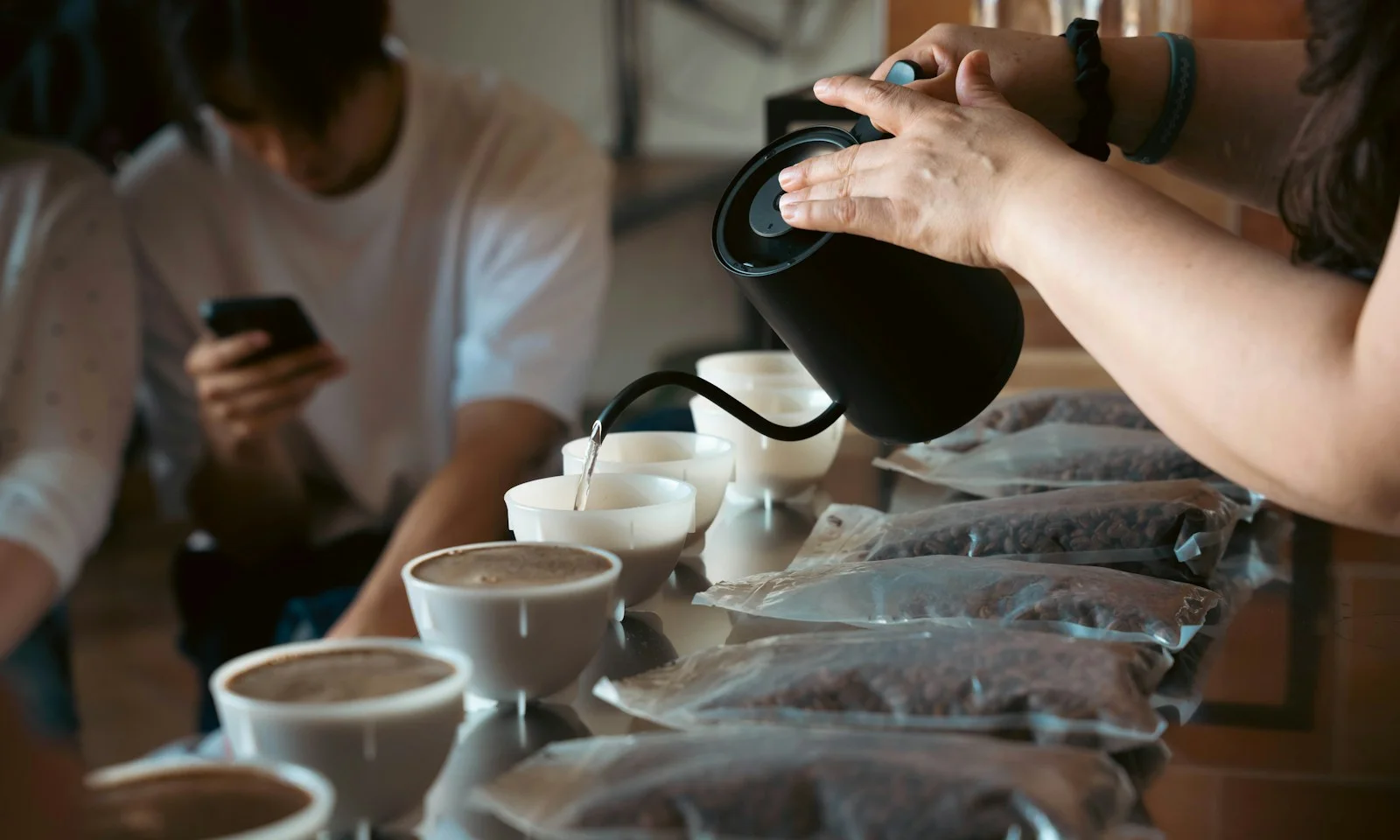
Coffee cupping water belongs in the lot-approval record. Verify calcium hardness, alkalinity, pH, chlorine and actual pour temperature, then identify the water batch used for every session. A TDS reading alone cannot establish compliance with the SCA water specification. Investigate water changes before attributing an unexpected cup result to the coffee.
A floral Ethiopian sample arrives, but your purchasing team finds its acidity muted and postpones approval. Before requesting another lot, check the water that reached the bowls. An unrecorded filter adjustment or a replacement bottled-water source can undermine the evidence behind a buying decision, even when the sample and roast are correctly identified.
This protocol helps roasters, green coffee buyers and origin laboratories make water a controlled input. It focuses on measurements, release records and corrective action. For the tasting workflow itself, use our evaluation of Ethiopian coffee samples.
Define the applicable cupping method and water specification before evaluating a purchase. For Coffee Value Assessment, SCA-102 provides the preparation requirements, including water chemistry and pouring temperature. Record the method version alongside the results so another laboratory can understand how the assessment was conducted.
The following values come from SCA Standard 102-2024, sections 7.3 and 7.4, Table 2, checked in September 2026. The standard says cupping water should meet its table specifications whenever possible. Document any departure; do not silently describe an adapted procedure as full compliance.
| Property | Published specification | What to record |
|---|---|---|
| Chlorine | None | Result, test method and detection limit |
| Calcium hardness | 50–175 ppm as CaCO3 | Calcium-specific result and reporting units |
| Alkalinity | At or near 40–70 ppm as CaCO3 | Result and titration method |
| pH | 6–8 | Result, sample temperature and meter check |
| Pour temperature | 93 ± 3°C | Measured pouring condition, not only the kettle setting |
Table 2 does not give a TDS range. Its hardness entry is specifically calcium hardness. An instrument reporting total hardness cannot establish the calcium contribution by itself. Keep those distinctions visible on the laboratory form, especially when a mineral recipe contains magnesium.
Within the applicable specification, adopt a repeatable house water profile. Broad compliance leaves room for laboratory variation. Agree a target and an investigation band based on the method, instrument resolution and repeatability you can demonstrate. Do not invent narrow tolerances that your test kit cannot resolve.
Use separate measurements for properties that answer different questions. Alkalinity describes acid-neutralizing capacity; hardness describes mineral contributions; pH describes the water's acid-base state at measurement. A conductivity-based TDS meter supplies a useful trend indicator, but not a complete chemical profile.
The USGS explanation of alkalinity describes its buffering role and measurement by acid titration. In a cupping laboratory, this matters because a change in buffering can change how coffee acidity presents. Water pH alone does not tell you how much acid the water can neutralize.
Confirm whether the test reports calcium hardness or total hardness before recording a pass. General hardness tests commonly include calcium and magnesium. Ask the test supplier or analytical laboratory for a calcium-specific method when evaluating the SCA table.
Write the units in full. A result expressed as milligrams per litre of calcium is not the same number as calcium hardness expressed as calcium-carbonate equivalent. Preserve the original laboratory report and any conversion method; do not paste an unlabeled mineral concentration into the acceptance field.
Use a handheld meter to identify a change from a qualified water batch, then investigate the change with the relevant tests. Matching TDS values do not establish matching alkalinity or calcium hardness. Different dissolved ions can produce similar displayed values.
Record the meter model, conductivity-to-TDS factor if applicable, calibration check and sample temperature. Follow its temperature compensation and operating instructions. A reading from hot kettle water should not be treated as interchangeable with a reading taken under the validated room-temperature method.
Test the water you will use after treatment and mixing. A municipal report, filter label or recipe describes only part of that chain. The batch may also reflect bypass settings, source changes, weighing errors or an incompletely mixed concentrate.
When formulating water, tools such as the Barista Hustle water calculator help organize hardness, alkalinity and mineral inputs. Verify the finished composition independently. A recipe's general-hardness target does not automatically satisfy a calcium-hardness requirement.
Assign a water batch ID and release it before grinding purchase samples. Use the same qualified batch throughout a session wherever practical. If a refill requires a different batch, record the change and establish that the replacement meets the same procedure before continuing.
Repeated topping-up and long uncovered hot holds can change the conditions you qualified. Establish a refill procedure and avoid treating leftover kettle water as an indefinitely stable reference. After descaling or replacing equipment, verify rinsing and run a blank before resuming evaluation.
Set test frequency according to source stability and the consequence of error. A freshly mixed batch needs qualification; a continuous treatment system needs an established monitoring plan and change triggers. Repeat qualification after a source, cartridge, bypass or formulation change. Keep staff tasting agreement within the separate cupping team calibration protocol.
Exchange the water specification with the sample evaluation, not only the final score. Origin and destination laboratories need enough preparation detail to investigate a difference. A matching commercial lot name is only the beginning of that handover.
At sample dispatch: ask the exporter to connect the water record to the exact sample and preparation stage. An offer sample drawn before final preparation should not quietly become the reference for a later milled lot. A precise water record cannot repair a sample-identity gap.
At the origin cupping table: request the measured pour temperature and timing, particularly for a highland laboratory. A kettle setpoint or the word "boiling" does not fully describe the delivered brewing condition. Record any local limitation and agree how the two laboratories will handle it.
At destination: verify that the buyer's water procedure has not changed between offer approval and arrival evaluation. A new filter cartridge or mineral batch belongs in the investigation record. Keep the initial observations, then conduct a controlled retest before deciding what the difference means.
For Ethiopian sourcing, these handover details allow the washing-station or dry-mill sample history, exporter preparation and buyer assessment to remain connected. They are practical control recommendations, not evidence that water explains every discrepancy. Our sample approval workflow covers the commercial decision attached to each sample stage.
Treat an unexpected sensory result as a reason to check the preparation record before changing the purchase decision. A controlled retest can identify whether the original session is dependable. It cannot prove the entire lot is acceptable or replace representative sampling.
A wholesale roaster is evaluating a washed Ethiopian lot for a floral filter offering. Its house water record specifies alkalinity of 50 mg/L as CaCO3, but a replacement batch measures 110 mg/L. These are hypothetical training values, not customer results. The team places the sensory approval on hold and checks the mixing record before asking the exporter for a different coffee.
The QC lead prepares a fresh qualified batch, confirms the sample identity and follows the approved roast and cupping procedure. The repeat session includes a familiar reference coffee and blind sample codes. Staff record descriptors independently before discussing whether the disputed result persists.
If the reference and candidate both return to their expected behavior, the evidence supports invalidating the affected session and issuing a replacement assessment. If the candidate remains unusual while the reference behaves normally, investigate the sample, roast and coffee further. Do not add an arbitrary score correction to compensate for the water.
The procurement insight is that water qualification acts as a gate on the evidence used to accept or reject a lot. Without that gate, a water change can send buyers searching for replacement coffee before they know whether the original assessment was valid. Record both sessions and the reason for the decision so purchasing does not mistake a retest for a change in supplier quality.
Keep one water record that can be retrieved from the coffee's sensory session ID. Include the method, measured results, equipment checks and disposition. An isolated photograph of a meter display leaves too much unexplained for a later buying review.
Add water changes to the same change-control calendar as grinder service and sample-roaster adjustments. Establish a baseline with a familiar reference coffee after a deliberate profile change, and tell the laboratory receiving your samples. This prevents an undocumented method change from appearing as a sudden shift in origin quality.
Reliable coffee cupping water makes the evaluation behind a purchase easier to reproduce and defend. Start with the applicable specification, measure the finished batch, preserve its identity through pouring and link the result to the lot decision. That gives the exporter and buyer a concrete place to start when their cups tell different stories.
Share your target cup profile and evaluation method with Ethio Coffee Import and Export PLC. Ask about available Ethiopian lots and the sample information needed for your buying review.
No. A conductivity-based TDS meter estimates dissolved solids but does not identify calcium hardness, alkalinity or chlorine. Use it to monitor drift from a qualified batch. Test the individual properties required by the cupping method, and retain the units, test methods and instrument checks with the session record.
No. Total hardness includes contributions from calcium and magnesium, while the SCA-102 water table specifies calcium hardness. A general-hardness reading does not isolate that contribution. Use a suitable calcium-specific test or laboratory result, and confirm that the reported units match the calcium-carbonate-equivalent units in the specification.
Unmineralized distilled water generally will not provide the calcium hardness and alkalinity specified for CVA cupping. Food-safe distilled water can serve as a base for a controlled mineral formulation. Measure the finished batch and document its recipe rather than assuming that any coffee-water mineral product meets the chosen method.
Repeat the affected evaluation when a water deviation makes the original buying evidence unreliable. Qualify the replacement water, preserve sample identity and use the approved preparation method with a reference coffee. Keep both records and explain which assessment supports the final decision; do not silently overwrite the initial result.
About This Insight: Published by Ethio Coffee Import and Export PLC, an origin-connected Ethiopian coffee exporter. This article combines cited technical requirements with proposed laboratory controls. The buyer scenario is illustrative; it is not a reported customer outcome. Published Sep 20, 2026.